5 Types of Business Loans in the Philippines (And How to Choose the Right One)
Quick Answer

Key Takeaways
- A credit line is the most flexible option for most SMEs — draw only what you need, pay interest only on what you use, and reuse it without reapplying.
- Term loans are better for large, one-time investments like equipment, real estate, or acquiring another business.
- Invoice/receivables financing is ideal for B2B businesses with long payment cycles — it turns unpaid invoices into immediate working capital.
- Project financing is a specialized structure for capital-intensive developments where debt is repaid strictly from the project's own future cash flows, not the borrower's balance sheet.
- Special-purpose government loans are targeted financing programs for new entrepreneurs, disadvantaged business owners, and newly-established MSMEs. They are not suitable for established businesses needing fast capital.
- Most business loans in the Philippines are either secured (require collateral) or unsecured (no collateral).
- As of August 2026, First Circle's Business Credit Line offers up to ₱25 million with no collateral and no setup fees. Monthly interest starts at 0.79%.
A business loan is essential for small and medium enterprises (SMEs) for many reasons, from covering cash flow gaps to accelerating business growth. For first-time borrowers, however, narrowing down the choices to just one or two business loans can be difficult. There are plenty of SME loans and business credit lines in the Philippines – and just as many financing sources.
Since no two businesses are alike, only you – as the business owner – can decide which type of business loan will suit you best. To help you decide, we've narrowed down which types are readily available in the Philippines – and the loan factors you need to consider for each, such as your purpose, your financial capacity, and the urgency of your needs.
What are the basic business loan requirements in the Philippines?
Before choosing a loan type, make sure your business can meet the standard requirements most Philippine lenders ask for. These typically include:
- A valid government-issued ID
- A completed loan application form
- DTI, SEC, and/or BIR Certificate of Registration
- Business permit or another official document showing your business address
- Audited Financial Statements (AFS) and/or Income Tax Returns (ITR) for at least 1-3 years of operations
- Other business documents such as Articles of Partnership or a General Information Sheet
- Collateral documents as needed, such as real estate documents
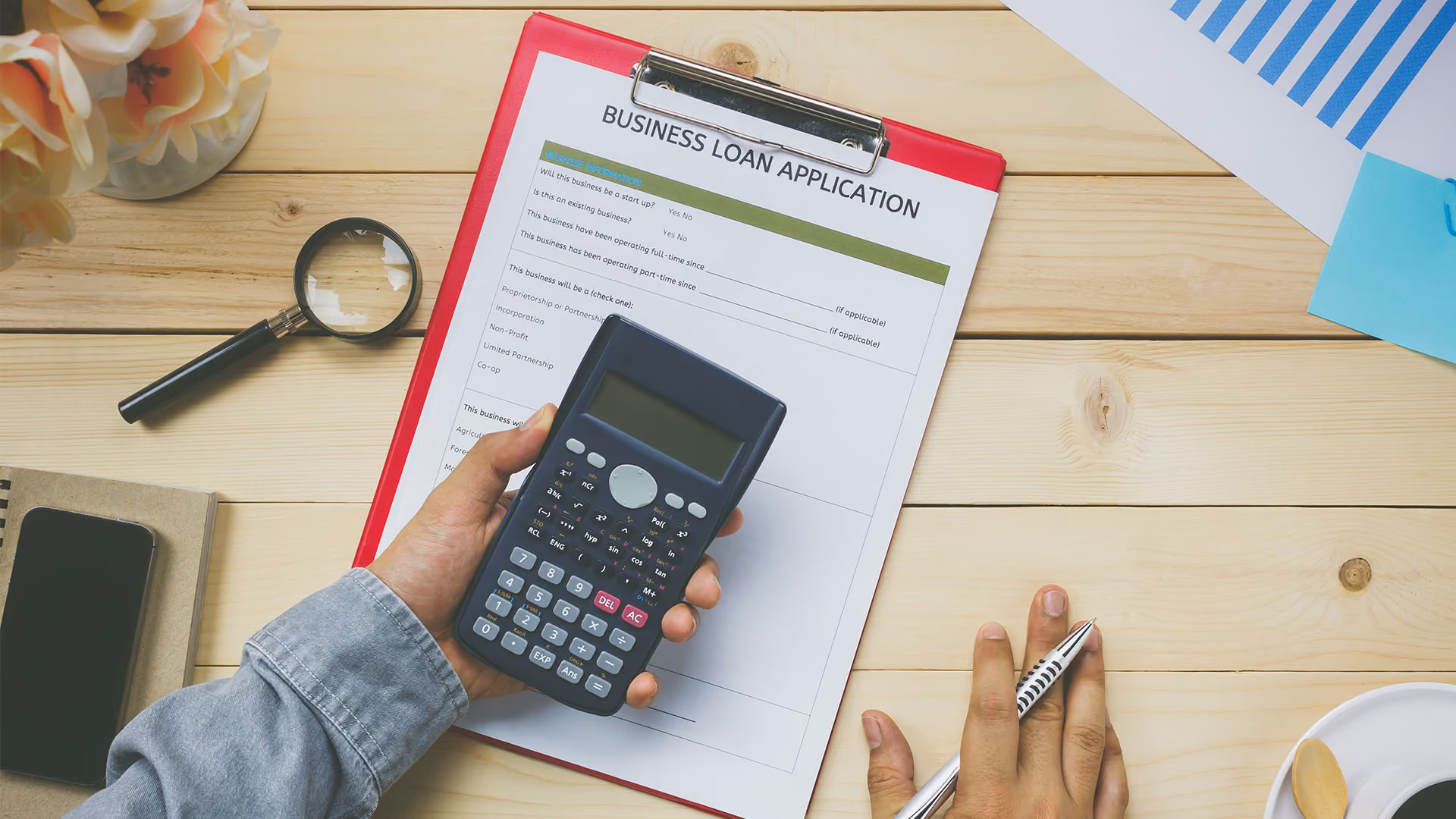
Requirements vary by lender and loan type, but non-collateral loans generally require fewer documents than collateral loans. See our guide to common business loan requirements for a full breakdown.
What Is the Difference Between a Collateral and Non-Collateral Business Loan?
Before getting into loan types, it helps to understand this distinction — because it applies across almost every category below.
A collateral loan, also known as a secured loan, requires collateral: real estate, bank deposits, or other valuable assets that the lender can seize if you default. Collateral loans typically offer higher amounts and lower interest rates, because the collateral reduces the lender's risk. In the Philippines, most traditional bank loans above ₱3 million require collateral.
A non-collateral loan, also known as an unsecured loan, requires no collateral. Because lenders take on more risk, unsecured loans tend to have smaller maximum amounts, higher interest rates, and shorter repayment terms — though this varies significantly by lender. First Circle's Business Credit Line is unsecured and goes up to ₱25 million, making it one of the largest no-collateral financing options available to Philippine SMEs.
Think of collateral vs. non-collateral loans not as loan types, but as a dimension of any loan — a term loan can be secured or unsecured; so can a credit line.
What Are the 5 Types of Business Loans in the Philippines?
- Term Loan — lump sum, fixed repayment schedule
- Credit Line / Line of Credit — revolving access to a set credit limit
- Receivables / Invoice Financing — cash advanced by the lender against a company's unpaid invoices or receivables
- Project Financing — long-term, non-recourse funding tied to a specific project's cash flows
- Special-Purpose Government Loans — targeted financing programs for women entrepreneurs, OFWs, disadvantaged business owners, and newly-established MSMEs
1. Term Loan
A term loan disburses a lump sum of cash upfront and is repaid over a fixed period — typically in monthly or quarterly installments. It is the most common business loan type in the Philippines. Most references to "corporate loans," "commercial loans," and "real estate loans" are describing a form of term loan.
Equipment loans, property loans, and fleet financing are a common variant of term loans. The asset being purchased (machinery, vehicles, technology) serves as collateral, which often makes it easier to qualify for larger amounts.
Best for: Large, one-time investments — building a new store, purchasing equipment or real estate, acquiring another business, or paying off existing debt.
Loan target market: Small, medium, and large businesses that have been operating for 1 year or more. For significant amounts over ₱3 million, businesses must be have at least 3 years in operations and profitability in the last 1 year.
Loan amount, terms, and repayment: Term loans typically go up to ₱20 million or more, depending on collateral provided. Repayment terms range from 1 to 20 years. Shorter terms mean higher monthly payments but lower overall interest. Longer terms mean more manageable monthly payments but higher total cost. Repayments of principal plus interest are typically done monthly or quarterly.
How to apply: Apply from the bank or provider’s office, branch, or website.
2. Credit Line

A credit line — also called a line of credit — gives your business access to a set credit limit that you can draw from as needed. You pay interest only on the amount you actually use. When you repay what you borrowed, your limit is replenished and you can borrow again, without having to reapply.
Best for: Short-term working capital needs, project funding, bridging cash flow gaps, or handling unexpected expenses like equipment repair or seasonal inventory increases. Since a credit line is always available, every business can benefit from setting up one — especially if you can get it free of charge with no maintaining fees.
Loan target market: Small, medium, and large businesses with established revenue, growth opportunities, or unpredictable cash flow.
Loan amount, terms, and repayment: Credit lines in the Philippines are available for up to ₱25 million, though amounts above ₱2 million often require collateral at traditional banks.
We'd be amiss if we don't mention our Business Credit Line, which is designed to be one of the most competitive and accessible credit financing for Philippine SMEs. Get up to ₱25 million* in credit with no collateral required, with monthly interest starting at 0.79% since August 2026. Partners can draw down funds same-day and pay only when they use it.
How to apply: With First Circle, you can apply online and receive a decision in as fast as 1–2 business days. Applications for bank-issued credit lines are typically done at a branch or the bank's website.
3. Receivables or Invoice Financing

Receivables financing — also called invoice financing or accounts receivable financing — allows businesses to convert outstanding invoices into immediate cash, rather than waiting 30, 60, or 90 days for clients to pay. A lender advances a percentage of the invoice value upfront; once your client pays, you receive the remaining balance minus a fee.
This is distinct from a business loan in the traditional sense: you're not borrowing against your assets or balance sheet, but unlocking cash that's already owed to your business.
Trade financing is a semi-related concept. It covers a broader range of instruments — such as letters of credit, supply chain financing, import/export financing — to facilitate and pay for your future business transactions with suppliers and traders. If your business involves cross-border trade or long supply chains, trade financing may be worth exploring alongside invoice financing.
Best for: B2B businesses with reliable clients but long payment cycles: distributors, manufacturers, contractors, and service businesses that invoice on 30–90 day terms.
Loan target market: SMEs with a consistent pipeline of receivables and creditworthy clients.
Loan amount, terms, and repayment: Lenders typically advance 70–90% of an invoice's face value. The remaining balance (minus fees) is released once your client settles the invoice. Terms are short because they are usually tied to the invoice payment cycle, rather than a fixed loan tenor.
How to apply: Application requirements typically include copies of outstanding invoices, proof of the business relationship, and basic financial documents.
4. Project Financing
Project financing is a specialized, long-term funding structure used for capital-intensive developments — such as infrastructure, real estate, energy, and large industrial projects. What makes it distinct from a term loan is where the repayment comes from. In project financing, the debt is repaid strictly from the project's own anticipated future cash flows rather than the borrower's corporate balance sheet.
This means lenders evaluate the project itself — its revenue projections, contracts, and risk structure — rather than the borrowing company's overall financial position. Projects are typically housed in a dedicated Special Purpose Vehicle (SPV) to ring-fence the project's assets and liabilities.

Typical structure: Project financing deals in the Philippines usually require a debt-to-equity ratio of around 60/40 — meaning the lender covers roughly 60% of the project cost, and the developer contributes 40% in equity.
Best for: Capital-intensive, long-term developments with predictable future cash flows: toll roads, power plants, mixed-use real estate, and large manufacturing facilities.
Loan target market: Corporations, developers, and institutional investors with major infrastructure or real estate projects. Several large Philippine banks offer project financing facilities for qualifying developments.
Loan amount, terms, and repayment: Project financing deals are typically large — often in the hundreds of millions to billions of pesos. Loan tenors are long, often 10–25 years, aligned to the project's revenue generation timeline.
How to apply: Applications are handled directly with banks or financial institutions offering project finance desks. Borrowers typically need to present a detailed feasibility study, financial models, long-term contracts and agreements with the project's suppliers, and proof of the equity contribution.
5. Special-Purpose Government Loans
Special-purpose government loans are targeted financing programs offered by government financial institutions for specific borrower groups, such as women entrepreneurs, OFWs, disadvantaged business owners, and newly-established MSMEs. Unlike general commercial loans, eligibility is defined by who you are as much as what your business needs.
These programs typically offer more accessible terms than commercial lenders — lower interest rates, smaller minimum loan amounts, and more flexible eligibility criteria — because they are designed to expand access to financing for groups that are underserved by traditional banks.

Best for: Women-owned businesses, OFW entrepreneurs, agrarian reform beneficiaries, cooperatives, micro-enterprises, and MSMEs in priority sectors or calamity-affected areas.
Loan target market: Specific borrower groups identified by government institutions as priority sectors — including but not limited to women entrepreneurs, OFWs, persons with disabilities, and newly-established MSMEs that may not yet qualify for commercial loans.
Loan amount, terms, and repayment: Amounts vary widely by program, ranging from as low as ₱5,000 to as high as ₱20 million. Interest rates are generally below commercial rates -- some programs offer 0% for the initial period, orrates as low as 1% per month on a diminishing balance. Repayment terms range from a few months to 10 years.
How to apply: Applications are typically submitted directly to the relevant government financial institution, such as SB Corp, DOST, or ACPC — at their offices, branches, or online portals. Requirements vary by program but generally include proof of eligibility for the specific borrower group, basic business documents, and a business plan or financial projections.
Which Type of Business Loan Is Right for My Business?
As a starting point, consider three things: what you need the money for, how quickly you need it, and whether you have collateral.
For most SMEs, a credit line is the most practical starting point, especially if you're not sure exactly how much you need to borrow. Credit lines are flexible, reusable, and available whenever you need it.
For large one-time investments needing over ₱5 million or more, a term loan can offer better rates and larger amounts — especially if you have assets to pledge.
If your business invoices clients on long payment terms, invoice financing can free up cash without taking on new debt. Meanwhile, major developers and corporations with long-horizon projects should explore project financing with a bank that has a dedicated project finance desk.
And if you belong to a priority group — women entrepreneurs, OFWs, or MSMEs in priority sectors such as agriculture or ICT— special-purpose government loan programs may offer more accessible terms than any commercial lender.
Always ensure you are dealing with a lender's official website, account, or loan representative. Scammers impersonating legitimate lenders are common in the business financing space.
A company loan may be necessary to take your business further — but it can also be a risky, problematic move if you don’t do the necessary legwork. To make an informed decision, understanding the best business loan type for you is crucial, as well as making a realistic repayment plan to reduce your risks of defaulting.
To better understand the interest rates and monthly repayment amounts you're comfortable with, see our guide to comparing business loan interest rates in the Philippines.
Frequently Asked Questions
What is the easiest business loan to get in the Philippines?
Non-collateral credit lines are generally the fastest and easiest business loans to access. For instance, our Business Credit Line can be approved in as fast as 1–2 business days through our one-minute online application. Traditional bank loans — especially secured term loans — typically have longer processing times and stricter document requirements.
What is the difference between a credit line and a term loan?
A term loan gives you a fixed lump sum upfront, repaid in scheduled installments over a set period. A credit line gives you access to a revolving credit limit — you draw only what you need, pay interest only on what you use, and your limit resets as you repay. Term loans suit large one-time purchases; credit lines suit ongoing or unpredictable working capital needs.
Can I get a business loan without collateral in the Philippines?
Yes. Unsecured business loans — including credit lines and invoice financing — are available without collateral, but expect to pay a higher interest rate for them than a collateral loan. For instance, First Circle's Business Credit Line offers up to ₱25 million with no collateral required.
Does First Circle offer business loans in the Philippines?
Yes. Our flagship product is the Business Credit Line — a revolving, no-collateral credit facility for Philippine SMEs, providing up to ₱25 million* in flexible working capital and monthly interest as low as 0.79%.
We also offer Express Business Loan, which provides ultra-fast, same-day disbursements with no interest, one-month repayment terms, and a fixed processing fee of 1-4%. Please be advised that you'll need an active Business Credit Line to take out an Express Business Loan.
For businesses that prefer longer repayment terms, we offer Business Credit Plus, a revolving credit line with loan periods of 13-24 months. Monthly interest rates start as low as 1.49%.
First Circle is a financing company regulated by the Securities and Exchange Commission (SEC) with email address at crmd_publicassistance@sec.gov.ph and contact numbers (+632) 8818−5554 and (+632) 8818−7163. Credit approval, limits, and rates granted may vary upon assessment based on existing First Circle policies.
How is First Circle's Processing Fee different from the Subscription Fee?
Before withdrawing a business loan, you’ll be asked to choose between two types of convenience fee: a Processing Fee or Subscription Fee.
Processing Fee is best if you don’t plan to withdraw often. This charges you 1.99% of your business loan withdrawal amount, and will only be charged whenever you use your credit line.
Subscription Fee is best if you expect to use your credit line frequently. This gives you unlimited withdrawals for the entirety of your credit line validity period. The fee will vary depending on your chosen frequency of subscription fee repayment: Annual (3.99% of line amount), Bi-Annual (4.8% of line amount), or Quarterly (6% of line amount).
This article is intended for general informational purposes only. It does not constitute financial, legal, or investment advice, and should not be relied upon as such. Loan product information, interest rates, and eligibility criteria for First Circle and third-party lenders are sourced from publicly available information as of August 2026 and are subject to change at any time without notice. First Circle makes no representations as to the accuracy or completeness of third-party information. Please contact each lender directly to verify current terms. Always consult a qualified financial or legal advisor before making borrowing decisions for your business.
First Circle Growth Finance Corp. is a financing company with SEC Registration No. CS201605477 and CA No. 1108. It is regulated by the Securities and Exchange Commission with the email flcd_queries@sec.gov.ph. For any questions, you may reach out to support@firstcircle.com.

Jess Jacutan
Apply online in 5 minutes
Only 3-7 documents needed
No paperwork, no branch visits — 100% online