

5 red flags to avoid when securing business loans
Summary

Key Takeaways
- Upfront payment requests: Advance-fee scams ask for a “processing” or “convenience” fee before releasing your loan, often through cash, crypto, or e-wallets.
- Too-good-to-be-true offers: A huge loan amount or very low rate offered without checking your income, assets, or credit history is a warning sign.
- Pressure tactics: Scammers rush you with “limited-time” offers, and some even threaten your credit history.
- No official loan documents: Legitimate lenders put the terms, amortization schedule, interest, and fees in writing.
- No verified online presence: Scammers can copy a real lender’s logo, website, and app, so always double-check.
- Verify with the SEC: Legitimate financing and lending companies must have SEC registration and a Certificate of Authority.
Business loans, business credit lines, and other forms of business financing are important lifelines to any business owner. Whether you own a small-to-medium enterprise (SME) or an industry giant, you’ll achieve more revenue by using borrowed money wisely.
Many entrepreneurs, however, still shy away from securing business loans from legitimate financing providers. Some worry that these providers are predatory, and they’ll charge high interest rates. Some cannot provide the numerous documents required by traditional lenders. Many find the process of borrowing too slow – which is no good if your cash flow gap is threatening to sink your operations now.
These concerns prompt some entrepreneurs to approach unknown lenders and impostors offering huge loan amounts, lower-than-average interest rates, and rapid processing. Sadly, many of these turn out to be scams.
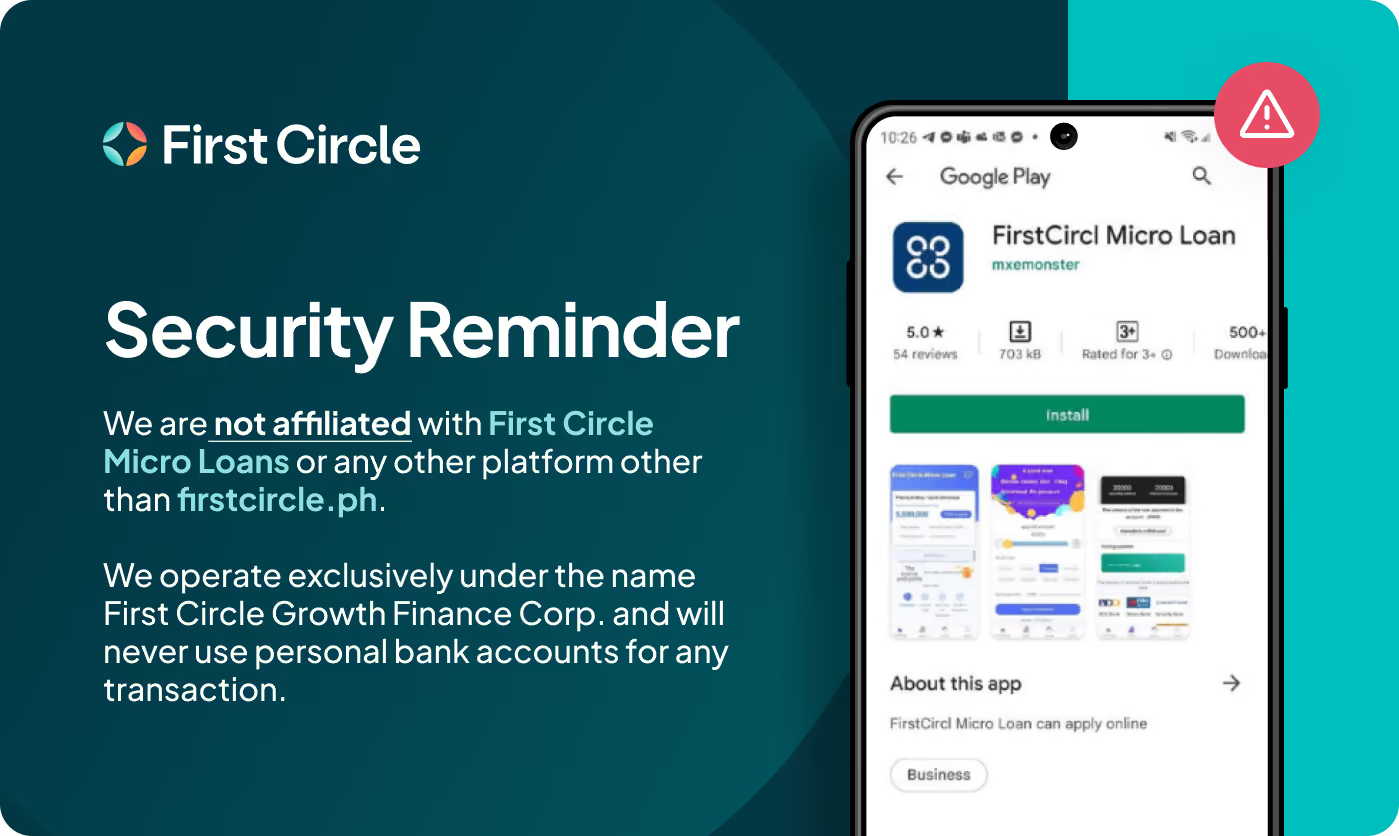
For instance, in March 2022, an impostor app on Google Play called FirstCircl Micro Loan used our logo to seem legitimate – promising instant loans of Php 30,000-Php 5 million for just 0.002% interest. The app also claimed a loan processing time of 3 days in exchange for a Php 600 fee. After sending the fee, the borrowers could no longer contact the scammers behind the app.
To avoid these instances and ensure you are only borrowing from legitimate financial providers, learn how to recognize these 5 red flags.
#1. The provider requests payment upfront
Also known as the Advance-Fee Loan scam, this is when a provider asks for payment first so you can access your loan amount. They often pass off the charge as a ‘processing fee’ or ‘convenience fee’ to process your application faster. Additionally, fake financial providers may ask you to pay via untraceable payment methods such as hard cash, cryptocurrency, or e-wallets.
First Circle does not charge application fees, and will never ask you to send payment to access your loan. The same goes for most legitimate financial institutions.
#2. Loan amount and interest rates are too good to be true
Is the credit limit being offered much higher than all other loan offers you’ve received? Is the interest rate far below what other lenders are offering, before anyone has even looked at your financials? Legitimate providers will only issue loan amounts and interest rates that are commensurate with your business income, assets, and capacity to pay. For example, First Circle’s Business Credit Line offers monthly interest as low as 0.79%, but the rate you receive depends on an assessment of your business.
Moreover, scammers do not take the time to appraise your credit history and ability to pay. They purposefully seek desperate borrowers who do not have financial documents, but are willing to pay fees to find quick funding.
Credit approval, limits, and rates granted may vary upon assessment based on existing First Circle policies.
#3. Pressure to decide as soon as possible
A business loan requires careful decision-making because it is a serious financial commitment. Good lenders will often walk you through the details of your business loan or revolving credit line before you take them. They give you time to ask questions and make sure you fully understand the terms before you sign.
In contrast, fake providers purposely give vague explanations. Instead, they repeatedly insist that their offer is on limited availability, and it will be gone if you don't avail it within the day. Some scammers even make threats like ruining your credit history or blocking you from banks to rush you further.
#4. No official loan offer documents
Scammers avoid paper trails to prevent incriminating evidence and transactions from being traced back to them. This is why they won’t send any documentation of their loan offers.
On the other hand, there are also predatory financial providers who may be legitimate, but you still want to steer clear from. These predatory lenders do not send official loan documents to prevent disclosing information such as:
- Terms and amortization schedule of a business loan
- Breakdown of how interest accrues overtime
- Percentage of where your loan payment goes to
- Other fees such as early payment fees and service fees
This is in contrast to legitimate and helpful financial providers, who outline the terms of a loan in an official loan offer document.
#5. The provider doesn't have a verified online presence
The most glaring red flag of a fake provider is a questionable online presence. Legitimate providers often have a strong online presence – a full-fledged website with valid SSL certificates, social media accounts with the verified blue checkmark, mentions from legitimate digital publications, and reviews on Google or other financial aggregators.
Some scammers, however, have developed more sophisticated ways to deceive. They can copy a legitimate provider’s branding, duplicate the legitimate website, or duplicate apps and fill it with positive reviews to increase credibility.
In the case of the fake app FirstCircl Micro Loan, the scammers used our branding, company name, address, and website links to communicate with customers via WhatsApp. The scammers also populated their fake app’s Google Play page with fake five-star reviews.
To stay safe when finding business funding, always ensure that you transact only with trusted and legitimate providers. The best way to confirm a financial provider’s legitimacy is to look them up on the Securities and Exchange Commission (SEC) website. The SEC requires all lending and financing companies to be registered and hold a Certificate of Authority to operate legally. First Circle is listed as “First Circle Growth Finance Corp.” (Certificate of Authority No. 1108). You’ll also find the list of providers with revoked licenses on the same website.
If you encounter a suspicious lender, you can report it to the SEC. Complaints against registered lending and financing companies can be filed through the SEC’s online complaints portal, while complaints against those lending without a Certificate of Authority can be sent to epd@sec.gov.ph.
In addition, always ensure that you are transacting with official providers strictly through the official channels they have listed on SEC or their website. For your reference, here are First Circle’s official channels:
- Website: https://www.firstcircle.ph/
- Facebook: https://www.facebook.com/firstcircleph
- LinkedIn: https://www.linkedin.com/company/firstcircle
- Twitter: https://twitter.com/firstcircleph
- Instagram: https://instagram.com/firstcircleph/
Lastly, do not give out your usernames, OTPs, PINs and passwords to anyone, even if they claim to be from a trusted provider. Legitimate financial partners like First Circle will never request for this information.

Business loans and funding from trustworthy partners like First Circle can truly help your company find success, so don’t let bad actors and malicious forces get in the way of your business growth. By being observant of red flags and taking steps to ensure a provider’s legitimacy, you will find the support that you need.
For more articles like this, check out https://www.firstcircle.ph/blog.
Frequently Asked Questions
How do I check if a lender is legitimate in the Philippines?
Look the lender up on the Securities and Exchange Commission (SEC) website. Legitimate financing and lending companies must be registered with the SEC and hold a Certificate of Authority, and their online lending platforms should appear on the SEC’s list of recorded online lending platforms.
What is an advance-fee loan scam?
An advance-fee loan scam is when a fake lender asks you to pay a fee, often called a “processing fee” or “convenience fee,” before you can receive your loan. Once you pay, the scammer disappears, and you never receive the loan.
Is a low interest rate a sign of a loan scam?
Not on its own. Legitimate lenders can offer low rates, but only after assessing your business income, assets, and capacity to pay. The red flag is a very low rate or very high loan amount offered without any review of your finances.
Where can I report an online lending scam in the Philippines?
Complaints against registered lending and financing companies can be filed through the SEC’s online complaints portal. Complaints against people or companies lending without a Certificate of Authority can be sent to the SEC’s Enforcement and Investor Protection Department at epd@sec.gov.ph.
What should I do if someone is impersonating a legitimate lender?
Stop all communication, don’t send any money or personal information, and contact the real lender through the official channels listed on its website or SEC records. Never share your usernames, OTPs, PINs, or passwords, even with someone claiming to be from a trusted provider.
Loan product information, interest rates, and eligibility criteria for First Circle as of date of publication are subject to change at any time without notice. First Circle Growth Finance Corp. is a financing company with SEC Registration No. CS201605477 and CA No. 1108. It is regulated by the Securities and Exchange Commission with the email flcd_queries@sec.gov.ph. For any questions, you may reach out to support@firstcircle.com.

Jess Jacutan
Get started with First Circle today
Apply for an account online in 5 minutes
Simply submit 3-7 documents to us
No paperwork, no branch visits — 100% online